

Your mouth isn’t just made up of teeth and gums.
It contains a complex ecosystem of microorganisms known as the oral microbiome. Some microorganisms are harmless or beneficial, while others can contribute to plaque, bad breath, tooth decay, and gum problems when the oral environment becomes disrupted.
This growing interest in the oral microbiome has also created a new category of supplements: oral probiotics.
Unlike traditional probiotics primarily marketed for digestive health, oral probiotics are designed to deliver selected microorganisms directly to the mouth, often through lozenges or chewable tablets.
But with so many products available, choosing one can be confusing.
Should you choose a multi-strain formula? Is a higher CFU count better? Which probiotic strains are actually worth looking for?
In this guide, we’ll compare some of the most notable oral probiotic options in 2026 and explain what makes each one different.
Important: Oral probiotics are supplements, not replacements for brushing, flossing, fluoride toothpaste, professional dental care, or treatment prescribed by your dentist.
Quick Answer: Which Oral Probiotic Is Best?
There isn’t a single oral probiotic that is automatically the best choice for everyone.
Different products use different strains, formulations, doses, and delivery methods.
For a quick overview:
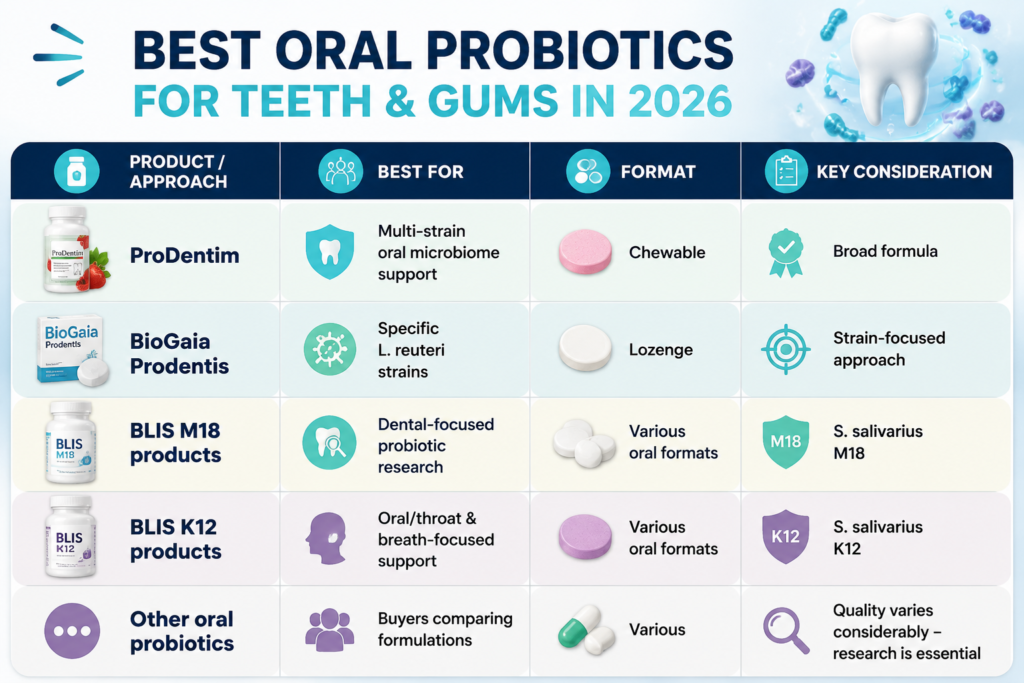
Our top picks
🥇 Best multi-strain option: ProDentim
🥈 Best for specific L. reuteri strains: BioGaia Prodentis
🥉 Best for M18-focused research: BLIS M18 products
⭐ Best for K12-focused oral/throat support: BLIS K12 products
However, these aren’t medical rankings. Your personal goals and the specific evidence behind a product’s strains matter more than a simple “number one” label.
What Are Oral Probiotics?
Probiotics are live microorganisms intended to provide a health benefit when consumed appropriately.
Oral probiotics are specifically formulated with strains that are intended to interact with the oral environment.
They’re commonly available as:
- Lozenges
- Chewable tablets
- Dissolvable tablets
- Powder or other oral formulations
The concept is different from traditional antibacterial approaches.
Instead of attempting to eliminate microorganisms indiscriminately, probiotics are being studied for their potential to influence the microbial environment by introducing selected microorganisms.
Research into oral probiotics is promising but still developing. Results can vary substantially depending on the strain, dose, formulation, and health outcome being studied.
Why Are People Taking Oral Probiotics?
Interest in oral probiotics has grown because researchers are studying their potential relationship with:
- Oral microbiome balance
- Gum health
- Plaque
- Bad breath
- Oral biofilms
- Tooth decay
- Periodontal health
But it’s important to distinguish research interest from proven treatment.
An oral probiotic shouldn’t be marketed as a cure for cavities, gum disease, infections, or other dental conditions.
How We Evaluated the Options
Rather than simply looking at which product has the biggest number on its label, we used several factors.
1. Probiotic strains
The exact strain matters.
“Probiotics” is a broad category, and different strains can have different properties.
2. Oral-health relevance
We looked at whether the strains or formulation have been investigated specifically in oral-health settings.
3. Delivery format
Lozenges and chewable products can be convenient because they are intended to remain in the mouth rather than being swallowed immediately.
4. Label transparency
A good product should clearly explain its ingredients, directions, and probiotic information.
5. Practicality
The best supplement is also one that fits realistically into a person’s routine.
6. Evidence limitations
We also considered an important distinction:
Research on a probiotic strain does not automatically prove that every commercial product containing that strain produces the same results.
1. ProDentim – Best Multi-Strain Oral Probiotic
⭐ Our Rating: 4.5/5
Best For: People interested in a multi-strain oral probiotic
ProDentim is a chewable probiotic supplement marketed specifically around oral microbiome support.
Its formulation uses multiple probiotic ingredients, including strains from the Lactobacillus and Bifidobacterium groups.
The chewable format is designed to be incorporated into an oral-care routine.
Why Consider ProDentim?
The main attraction is its multi-strain approach.
Instead of focusing on one probiotic strain, the formula combines several ingredients into one product.
It may appeal to people who want:
- A convenient chewable format
- A multi-strain formula
- A product specifically marketed for oral health
- An easy addition to an existing oral-care routine
Potential Downsides
One important consideration is that research involving individual probiotic strains shouldn’t automatically be interpreted as clinical proof for an entire finished supplement.
Consumers should also consider:
- Exact strain information
- Dosage
- Ingredient transparency
- Price
- Individual suitability
Who Might Prefer It?
ProDentim may appeal most to someone who prefers a broad, multi-strain approach rather than a single-strain probiotic.
Want More Details?
👉 Read our complete ProDentim Review 2026 to see its ingredients, formulation, potential benefits, pricing considerations, and who may want to consider it.
Want To Buy ProDentim??
Check Out The Price Plan Here>>
2. BioGaia Prodentis – Best for Specific L. reuteri Strains
⭐ Our Rating: 4.5/5
Best For: People who prioritize strain-specific information
BioGaia Prodentis takes a more focused approach.
The product contains two specific strains of Lactobacillus reuteri:
- L. reuteri DSM 17938
- L. reuteri ATCC PTA 5289
It is provided as an oral lozenge designed to dissolve in the mouth.
Why Consider It?
One of its biggest advantages is strain specificity.
Rather than simply listing a broad probiotic category, the product identifies the particular strains used.
That can be useful for consumers who want to research the clinical literature surrounding individual strains.
Potential Downsides
The formulation is more focused than a multi-strain product.
Someone looking for a broader combination of probiotic microorganisms may prefer a different formula.
Best For
BioGaia Prodentis may be a good option for consumers who prioritize:
- Specific probiotic strains
- L. reuteri research
- A lozenge format
- A relatively focused formulation
3. BLIS M18 Products – Best for Dental-Focused Research
⭐ Our Rating: 4.5/5
Best For: People researching S. salivarius M18
BLIS M18 is a specific strain of Streptococcus salivarius that has been studied in connection with oral health.
It is important to understand that BLIS M18 is a probiotic strain, not one single consumer product.
Different manufacturers can use the strain in different formulations.
Why Is M18 Interesting?
M18 has attracted attention because researchers have investigated its potential relationship with:
- Dental plaque
- Oral biofilms
- Gum health
- Oral microbial balance
Potential Downsides
The biggest issue is that consumers need to evaluate the actual finished product, not just the presence of M18.
Check:
- Strain identification
- CFU amount
- Other ingredients
- Directions
- Manufacturer information
Best For
M18-based products may appeal to people who specifically want to investigate a probiotic strain associated with dental-health research.
4. BLIS K12 Products – Best for Oral & Breath-Focused Support
⭐ Our Rating: 4/5
Best For: People interested in K12 and oral/throat support
BLIS K12 is another strain of Streptococcus salivarius.
However, K12 and M18 shouldn’t be treated as interchangeable.
They have different research profiles and are often marketed toward somewhat different oral-health goals.
K12 has attracted interest particularly around oral, throat, and breath-related applications.
Potential Advantages
- Specific strain identification
- Oral-origin probiotic
- Convenient oral delivery in many products
- Interesting research surrounding oral and throat health
Potential Downsides
K12 may not be the first choice for someone specifically looking for a dental-health-focused formulation.
As always, evaluate the finished product rather than assuming every K12 product is identical.
5. Other Oral Probiotic Supplements
Beyond the products above, you’ll find many other oral probiotic supplements online.
Some contain:
- Lactobacillus strains
- Bifidobacterium strains
- Streptococcus strains
- Multiple probiotic strains
- Additional vitamins or minerals
- Herbal ingredients
The quality can vary significantly.
Before purchasing an unfamiliar product, look for clear information about:
✅ Exact probiotic strains
✅ CFU count
✅ Serving size
✅ Expiration information
✅ Storage requirements
✅ Full ingredient list
✅ Manufacturer details
Avoid choosing a product solely because it advertises the highest CFU number.
The Biggest Mistake: Thinking More CFUs Means Better
One of the most common misconceptions about probiotics is:
More CFUs = better probiotic
Not necessarily.
CFU stands for colony-forming units, which is a measurement used to indicate viable microorganisms.
But probiotic quality isn’t determined by CFU count alone.
For example, a product containing a large number of poorly studied or unidentified microorganisms isn’t automatically superior to a lower-dose product containing a specific, well-researched strain.
When comparing oral probiotics, consider:
Strain → Evidence → Dose → Delivery → Product quality
rather than simply:
CFU → Price → Marketing claims
Which Oral Probiotic Strains Should You Look For?
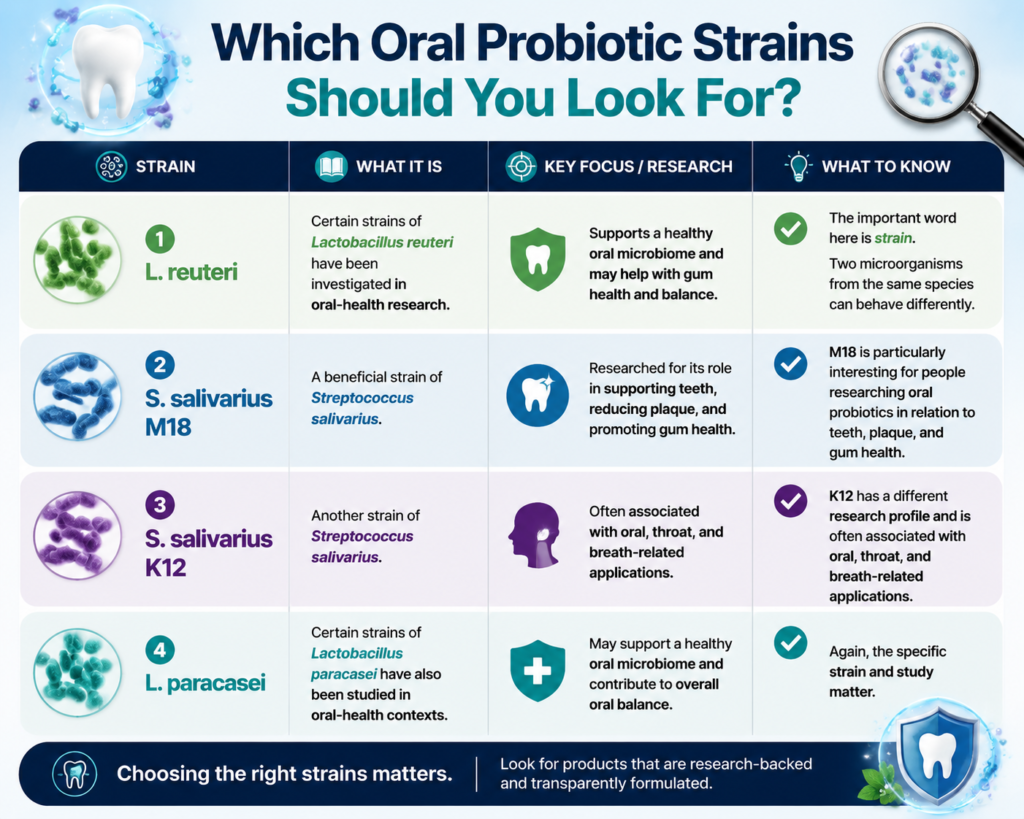
L. reuteri
Certain strains of Lactobacillus reuteri have been investigated in oral-health research.
The important word here is strain.
Two microorganisms from the same species can behave differently.
S. salivarius M18
M18 is particularly interesting for people researching oral probiotics in relation to teeth, plaque, and gum health.
S. salivarius K12
K12 has a different research profile and is often associated with oral, throat, and breath-related applications.
L. paracasei
Certain Lactobacillus paracasei strains have also been studied in oral-health contexts.
Again, the specific strain and study matter.
Oral Probiotics vs. Regular Probiotics
You may be wondering:
Can’t I just take my normal gut probiotic for my teeth?
Not necessarily.
Traditional probiotics are often designed primarily around digestive-health applications.
Oral probiotics are formulated with microorganisms selected for their potential interaction with the oral environment.
This doesn’t mean one category is universally better.
It simply means you should match the product to your intended purpose.
What About Oral Probiotics for Bad Breath?
Bad breath is one of the most common reasons people become interested in oral probiotics.
Certain microorganisms can contribute to unpleasant-smelling volatile sulfur compounds.
Researchers have investigated whether specific probiotic strains can influence these compounds and the microorganisms associated with them.
However, persistent bad breath can have many causes, including:
- Poor oral hygiene
- Gum disease
- Tongue coating
- Dry mouth
- Certain foods
- Smoking
- Dental infections
- Some medical conditions
Therefore, an oral probiotic shouldn’t be used to mask a persistent dental problem.
If bad breath continues despite good oral hygiene, consider talking with a dentist.
Can Oral Probiotics Help Gum Health?
This is one of the most frequently researched areas.
Some clinical studies have reported improvements in certain measures of gum or periodontal health when probiotics are used alongside conventional care.
However, results vary.
The evidence doesn’t mean that probiotics can replace professional periodontal treatment.
Think of them as a potential supplemental tool, not a standalone treatment.
Can Oral Probiotics Prevent Cavities?
This area is still being investigated.
Researchers are interested in whether certain probiotic strains can influence microorganisms associated with tooth decay.
But there is currently no reason to abandon proven cavity-prevention strategies.
For everyday cavity prevention, the basics remain important:
- Brush twice daily with fluoride toothpaste
- Clean between your teeth
- Limit frequent sugary snacks and drinks
- Drink water
- Visit your dentist regularly
An oral probiotic should never be considered a replacement for fluoride toothpaste or dental care.
What Is the Best Oral Probiotic for You?
Instead of asking:
“Which probiotic is number one?”
Ask:
What am I trying to support?
For example:
Broad oral microbiome support:
A multi-strain product such as ProDentim may appeal to you.
Specific L. reuteri research:
A product such as BioGaia Prodentis may be more interesting.
Dental-focused M18 research:
Look into products containing S. salivarius M18.
Oral/throat or breath-focused K12 research:
A K12-based product may be worth investigating.
This approach makes more sense than choosing a product based solely on a ranking.
7 Things to Check Before Buying an Oral Probiotic
1. Exact Strain
Look beyond the word “probiotic.”
Check the complete strain name whenever possible.
2. Human Research
Look for human clinical research rather than relying solely on laboratory studies.
3. CFU Information
The label should clearly explain the amount of probiotic microorganisms provided.
4. Expiration and Storage
Probiotic viability can be affected by storage conditions.
Follow the manufacturer’s storage instructions.
5. Additional Ingredients
Check for sweeteners, allergens, flavors, fillers, and other ingredients.
6. Delivery Method
A dissolving lozenge or chewable may be more appropriate for an oral probiotic than simply swallowing a traditional capsule, depending on the product design.
7. Manufacturer Transparency
Look for clear information about:
- Ingredients
- Directions
- Serving size
- Manufacturer
- Contact information
- Product storage
ProDentim vs. Other Oral Probiotics
Here’s a simple way to think about the major differences:
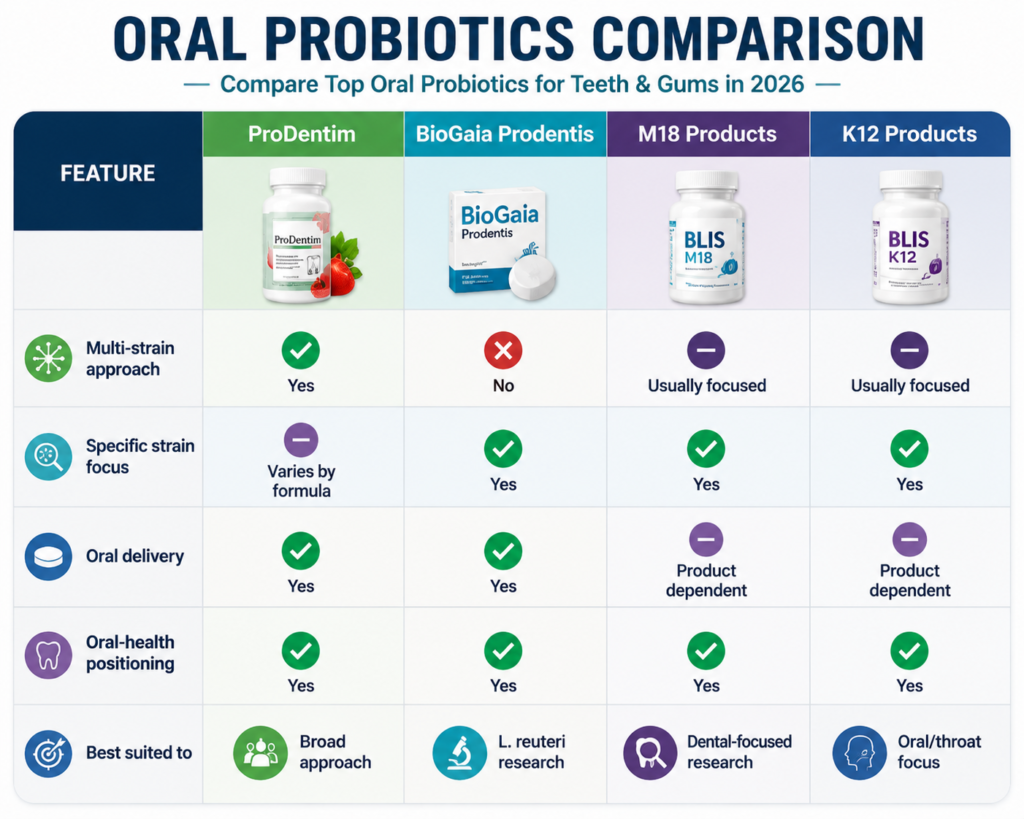
Important: Product formulations can change, so always verify the current label before purchasing.
Are Oral Probiotics Safe?
Probiotics are generally well tolerated by many healthy people, but “natural” doesn’t automatically mean “appropriate for everyone.”
If you:
- Have a serious underlying illness
- Have a compromised immune system
- Are pregnant or breastfeeding
- Take multiple medications
- Have significant dental disease
it’s sensible to ask your healthcare professional or dentist before starting a new supplement.
When You Should See a Dentist Instead
Don’t rely on oral probiotics if you’re experiencing symptoms that may require professional treatment.
See a dentist if you have:
🚨 Persistent gum bleeding
🚨 Severe tooth pain
🚨 Facial or gum swelling
🚨 Loose teeth
🚨 Signs of infection
🚨 Persistent mouth sores
🚨 Severe sensitivity
🚨 Ongoing bad breath despite good hygiene
Supplements can’t diagnose or treat these underlying problems.
How to Build a Better Oral-Care Routine
An oral probiotic works best, if you choose to use one, as part of a broader routine.
Morning
🪥 Brush with fluoride toothpaste
💧 Drink water
👅 Clean your tongue if desired
During the Day
🥗 Eat a balanced diet
🍬 Limit frequent sugary snacks
💧 Stay hydrated
Evening
🪥 Brush again
🧵 Clean between your teeth
🦷 Follow any dental recommendations
Optional
Consider an oral probiotic according to the product’s instructions.
This approach keeps the fundamentals where they belong: at the center of your oral-care routine.
Final Ranking: Best Oral Probiotics in 2026
After considering formulation, strain approach, delivery method, transparency, and intended use, here’s our simplified comparison.
🥇 ProDentim
Best Multi-Strain Oral Probiotic
A convenient option for people interested in a broad oral-microbiome supplement.
Rating: 4.5/5
👉 Read our full ProDentim Review 2026
🥈 BioGaia Prodentis
Best for Specific L. reuteri Strains
A focused option for people who prioritize clearly identified L. reuteri strains.
Rating: 4.5/5
🥉 BLIS M18 Products
Best for Dental-Focused Strain Research
An interesting option for consumers researching S. salivarius M18.
Rating: 4.5/5
⭐ BLIS K12 Products
Best for Oral/Throat & Breath Focus
Worth researching for people particularly interested in K12.
Rating: 4/5
Final Verdict: Are Oral Probiotics Worth Trying?
Oral probiotics are an interesting development in modern oral-health research.
The concept makes sense: instead of focusing exclusively on removing bacteria, researchers are investigating whether selected microorganisms can help influence the balance of the oral microbiome.
But there’s an important distinction between promising research and proven treatment.
If you’re considering an oral probiotic in 2026, don’t choose one simply because it has the highest CFU count or the most impressive marketing.
Instead, look at:
✔ Specific strains
✔ Human clinical evidence
✔ Clear labeling
✔ Appropriate oral delivery
✔ Product quality
✔ Your personal oral-health goals
For someone looking for a broad multi-strain approach, ProDentim is one option worth researching.
If you prefer a product built around specific L. reuteri strains, BioGaia Prodentis may be more appealing.
And if your interest is specifically in S. salivarius M18 or K12, products using those strains are worth comparing.
Ultimately, the best oral probiotic is the one that fits your needs, has transparent labeling, and complements—not replaces—good dental care.
Frequently Asked Questions
What is the best oral probiotic for teeth and gums?
There is no universally best oral probiotic. Different products contain different strains and formulations. ProDentim, BioGaia Prodentis, and M18-based products are among the options consumers may want to research.
Read More About The Best Oral Probiotics Here>>
Are oral probiotics better than regular probiotics?
Not necessarily better—just different. Oral probiotics are specifically formulated around microorganisms intended for the oral environment, while many traditional probiotics focus primarily on digestive health.
Can oral probiotics replace brushing?
No. Brushing with fluoride toothpaste remains one of the most important ways to protect against tooth decay.
Can oral probiotics replace flossing?
No. Oral probiotics should not replace cleaning between your teeth.
How long should I take an oral probiotic?
There is no universal timeframe. Follow the directions for the specific product and discuss long-term use with a healthcare professional if you have concerns.
Can oral probiotics help bad breath?
Certain oral probiotic strains have been studied for their potential relationship with bad breath, but persistent halitosis can have many causes and should be evaluated by a dental professional.
Should I take an oral probiotic every day?
Follow the specific manufacturer’s directions. Different products have different recommended serving schedules.
Related Articles
Read Next:
👉 ProDentim Review 2026: Does This Oral Probiotic Really Improve Teeth & Gum Health?
👉 7 Signs Your Oral Microbiome Is Out of Balance (And How to Restore It Naturally)
