

Before You Buy Mitolyn, Read the Formula Differently
Most supplement reviews start with a list.
Ingredient 1. Ingredient 2. Ingredient 3.
Then come the benefits, a few positive statements, and finally a purchase button.
But that approach doesn’t answer the question most shoppers actually have:
Does the formula make sense—or is it simply a collection of impressive-sounding ingredients?
That’s what we’re investigating here.
Mitolyn is marketed around mitochondrial function, cellular energy and healthy metabolic function. Its product information describes a six-ingredient formula featuring:
Maqui Berry • Rhodiola • Haematococcus • Amla • Theobroma cacao • Schisandra
The interesting part isn’t simply that these ingredients are present.
It’s whether their individual properties actually support the bigger claims being made about the finished supplement.
And there’s an important distinction to keep in mind from the beginning:
Evidence that an ingredient has interesting biological properties does not automatically prove that Mitolyn itself produces predictable weight loss.
So let’s investigate the formula from the inside out.
Want to check the current Mitolyn formula, pricing, and availability?
[Check Mitolyn on the Official Website →]
The Mitolyn Formula: First Look
Before discussing individual ingredients, here’s the formula at a glance.
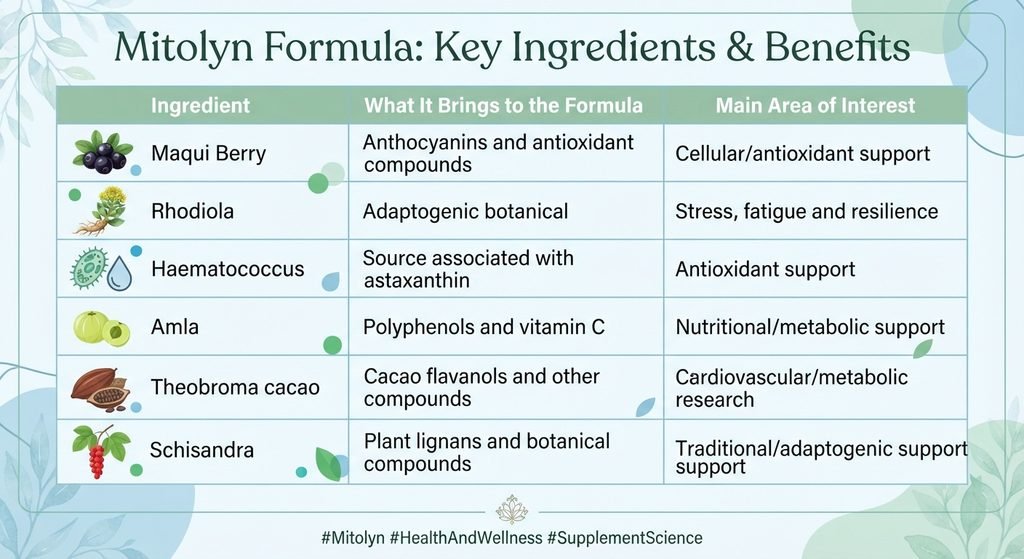
At first glance, the formula has a clear theme.
It’s not built around one conventional stimulant or one obvious “fat burner.”
Instead, it combines several botanicals associated with antioxidants, cellular function, energy and metabolic wellness.
That makes the formula interesting.
But interesting isn’t the same as proven.
Check the Current Mitolyn Formula →
The Real Question: What Is Mitolyn Trying to Do?
To understand the ingredients, you first need to understand the idea behind the product.
The central concept is mitochondrial health.
Mitochondria are structures within cells that play a major role in producing usable energy from nutrients.
That’s established biology.
The marketing logic then becomes:
Mitochondrial health → cellular energy → metabolic function → weight-management support
The first part of that chain is easy to understand.
The final part is where things become considerably more complicated.
Body weight isn’t controlled by one biological pathway.
It is influenced by:
- Food intake
- Physical activity
- Sleep
- Stress
- Genetics
- Medications
- Existing health conditions
- Overall energy balance
So the reasonable question isn’t:
“Can Mitolyn completely change my metabolism?”
A better question is:
“Do the ingredients provide enough evidence to justify using this formula as part of a broader wellness and weight-management routine?”
That’s a much harder—and more useful—question.
Ingredient Investigation #1: Maqui Berry
What is it?
Maqui Berry comes from Aristotelia chilensis, a South American plant.
One reason it appears in wellness formulas is its concentration of anthocyanins, naturally occurring plant compounds associated with antioxidant activity.
Why would Mitolyn use it?
The answer fits neatly with the product’s cellular-health positioning.
Antioxidants are studied because oxidative stress can affect cells and tissues.
That makes Maqui Berry a logical ingredient for a formula emphasizing cellular wellness.
But is it a fat burner?
This is where the marketing needs to be separated from the science.
Antioxidant activity ≠ automatic fat loss.
Those are different outcomes.
A useful way to think about Maqui Berry is:
Potential role: antioxidant and plant-based cellular support.
Not established: predictable or significant weight loss simply from consuming the ingredient.
The original formula description makes the same distinction: Maqui Berry is better viewed as an antioxidant component of the overall formula than as a guaranteed fat-burning ingredient.
Formula verdict
Interesting ingredient? Yes.
Standalone weight-loss solution? No evidence here to justify that conclusion.
Ingredient Investigation #2: Rhodiola
Now the formula moves into a completely different category.
Rhodiola is commonly described as an adaptogenic botanical.
It’s traditionally associated with areas such as:
- Fatigue
- Stress
- Physical performance
- Resilience
Mitolyn includes Rhodiola as part of its broader energy and wellness concept.
Why does this matter for weight management?
Because weight management isn’t purely about calories.
Someone dealing with persistent fatigue may struggle to:
- Exercise consistently
- Prepare healthy meals
- Maintain routines
- Stay physically active throughout the day
So an ingredient associated with energy and resilience can make sense indirectly within a lifestyle-oriented formula.
But don’t make the mistake of turning that into:
Rhodiola = weight loss.
That’s not what the evidence described in the source establishes.
Formula verdict
Rhodiola makes sense as a supporting wellness ingredient.
Its presence doesn’t prove that Mitolyn burns body fat.
Ingredient Investigation #3: Haematococcus
This is probably one of the less familiar names on the label.
Haematococcus refers to a type of microalgae associated with the antioxidant compound astaxanthin.
Astaxanthin has attracted considerable scientific interest because of its antioxidant properties.
And once again, the ingredient fits Mitolyn’s cellular-health positioning.
But here’s the question consumers should ask:
Does antioxidant activity automatically equal increased metabolism?
No.
A supplement ingredient can have a legitimate biological function without producing the dramatic consumer outcome suggested by advertising.
That’s why Haematococcus should be viewed primarily as an antioxidant-oriented component of the formula, not proof that Mitolyn will automatically increase metabolic rate or deliver a particular amount of weight loss.
Formula verdict
Good conceptual fit for the formula.
Not enough by itself to establish a weight-loss effect.
Ingredient Investigation #4: Amla
Now we reach Amla, also known as Indian gooseberry.
Amla has a long history of use in traditional health practices and contains plant compounds including polyphenols and vitamin C.
This makes it another ingredient that fits the formula’s nutritional and antioxidant theme.
Where does Amla fit?
Rather than thinking:
“Amla burns fat.”
Think:
“Amla is a plant-based ingredient with nutritional and metabolic-health interest.”
That’s a much more defensible interpretation.
The source material also recommends treating Amla as a supporting nutritional ingredient rather than a standalone weight-loss solution.
Formula verdict
Amla strengthens the formula’s overall nutritional profile.
But again, one ingredient doesn’t prove the performance of the entire supplement.
Ingredient Investigation #5: Theobroma Cacao
The scientific name may look complicated, but the underlying plant is familiar:
cacao.
Theobroma cacao contains naturally occurring compounds including flavanols, such as epicatechin.
Cacao flavanols have attracted research interest, particularly around cardiovascular and vascular effects.
That gives this ingredient a different role from some of the other botanicals.
The important question
Does cacao automatically make Mitolyn a weight-loss supplement that will burn fat?
Again, no.
The presence of biologically active compounds is not the same thing as proof of a specific clinical outcome.
The ingredient makes sense as part of a broader nutritional formula.
It shouldn’t be treated as a magic metabolism accelerator.
Formula verdict
Scientifically interesting? Yes.
Proof of significant weight loss from Mitolyn? No.
Ingredient Investigation #6: Schisandra
The final ingredient is Schisandra, a berry traditionally used in herbal medicine.
It contains various plant compounds and is commonly described as an adaptogenic botanical.
Its presence reinforces the overall botanical character of the formula.
But Schisandra also illustrates one of the biggest problems with supplement marketing.
There is a huge difference between:
“This plant contains biologically interesting compounds.”
and:
“This supplement will make you lose a predictable amount of body fat.”
The second statement requires substantially stronger evidence.
Formula verdict
Schisandra is an interesting supporting botanical.
It should not be interpreted as independently proving Mitolyn’s weight-loss claims.
So, is Mitolyn worth investigating?
If you want to see the complete formula, current serving information, and official product details, you can check the manufacturer’s current page here:
[See Mitolyn Formula & Official Details →]
Six Ingredients. One Formula. But Do They Actually Work Together?
This is arguably the most important section of the entire review.
Why?
Because consumers often make this mistake:
Ingredient A has research.
Ingredient B has research.
Ingredient C has research.
Therefore:
Product ABC must work.
Not necessarily.
Mitolyn is presented as a multi-ingredient formula intended to support areas such as:
- Cellular energy
- Antioxidant protection
- Normal metabolic function
- Daily energy
- Healthy weight-management habits
That’s a reasonable formula concept.
But it introduces a scientific problem.
Which ingredient is actually responsible for the effect?
If someone notices a benefit after using a six-ingredient formula, it can be difficult to determine whether the result came from:
- One ingredient
- Several ingredients working together
- Lifestyle changes
- Placebo effects
- Natural variation
And there’s an even bigger issue:
Research on an individual ingredient does not automatically prove the effectiveness of a commercial combination at its exact doses.
That distinction is crucial.
The Evidence Ladder: How Strong Is the Proof?
Here’s a better way to evaluate Mitolyn.
Imagine four levels of evidence:
Level 1 — Interesting biology
The ingredient has compounds that appear biologically active.
Useful? Yes.
Enough to prove weight loss? No.
Level 2 — Ingredient research
Researchers investigate the individual ingredient.
That’s more useful, but still doesn’t prove the finished product.
Level 3 — Dose-specific research
A particular extract or dose is studied.
Now the evidence becomes more meaningful.
But you still need to know whether the commercial product uses the same preparation and amount.
Level 4 — Finished-product clinical trials
This is the gold standard for evaluating a specific supplement.
Researchers test the actual product in humans under controlled conditions.
That’s the type of evidence consumers should look for when a supplement makes strong weight-loss claims.
The source material makes this hierarchy explicit: ingredient research, dosage research, finished-product research and large controlled clinical trials are not equivalent forms of evidence.
Ready to examine the product for yourself?
[Check Mitolyn on the Official Website →]
What About Mitolyn’s Stimulant Claims?
This is another area where you shouldn’t rely on an old review.
Some Mitolyn pages describe the product as plant-based and non-stimulant, while formulation information available online can vary.
Therefore, the practical advice is simple:
Check the current Supplement Facts label.
Don’t rely entirely on:
- An old blog post
- A random review
- A social-media advertisement
- A screenshot
- A third-party ingredient list
This is particularly important if you are sensitive to stimulants or take medications.
The Biggest Red Flag Isn’t Necessarily the Ingredients
Here’s the twist.
Looking at the six ingredients, there isn’t an obvious reason to dismiss the formula simply because the ingredients are unfamiliar.
The bigger issue is how far the marketing jumps beyond the evidence.
There’s a substantial difference between saying:
“These ingredients may support cellular and metabolic wellness.”
and saying:
“This formula will dramatically accelerate your metabolism and melt away fat.”
The first is a cautious supplement-positioning statement.
The second requires strong clinical evidence.
That’s why a smart Mitolyn review shouldn’t simply count ingredients.
It should evaluate the evidence chain.
What Mitolyn Can—and Can’t—Realistically Promise
Let’s make this simple.
Reasonable expectations
Mitolyn can be viewed as a dietary supplement designed around:
✔ Plant-based ingredients
✔ Antioxidant support
✔ Cellular wellness
✔ Metabolic-health support
✔ Daily wellness
✔ A broader lifestyle approach to weight management
Expectations that need caution
Be skeptical of claims suggesting:
✘ Guaranteed weight loss
✘ Effortless fat burning
✘ Dramatic results without lifestyle changes
✘ Predictable pounds lost by every user
✘ A supplement replacing diet and exercise
The original material emphasizes this same principle: a supplement should be considered one component of a broader health routine, not a replacement for nutrition, physical activity, sleep or other healthy behaviors.
The Lifestyle Test
Here’s a simple thought experiment.
Imagine two people take the same supplement.
Person A
- Eats mostly nutrient-dense foods
- Gets adequate protein and fiber
- Exercises regularly
- Sleeps well
- Maintains a sustainable calorie intake
- Manages stress
Person B
- Frequently overeats
- Rarely exercises
- Sleeps poorly
- Has a highly inconsistent routine
Should we expect the same result?
Probably not.
That’s why supplements should be considered supporting tools, not substitutes for fundamentals.
Mitolyn’s formula may fit into a healthy routine.
It shouldn’t be expected to perform the entire job.
Who Should Think Twice Before Taking Mitolyn?
“Natural” doesn’t automatically mean appropriate for everyone.
According to the source material, people should speak with a healthcare professional before using a supplement if they:
- Are pregnant or breastfeeding
- Take prescription medication
- Have a chronic medical condition
- Have allergies or sensitivities
- Are preparing for surgery
- Already use multiple supplements
Herbal ingredients can interact with medications.
So if you’re taking medications or managing a medical condition, professional advice is more important than an online review.
The Mitolyn Buyer Checklist
Before purchasing, don’t stop at the ingredient list.
Check these seven things:
1. Current Supplement Facts
Are the ingredients and amounts clearly listed?
2. Dosages
How much of each ingredient are you actually receiving?
3. Extract information
Is the product using a standardized extract where appropriate?
4. Evidence
Is the evidence about the actual product—or just individual ingredients?
5. Marketing claims
Are the promises realistic?
6. Safety information
Are warnings, interactions and usage instructions clearly provided?
7. Your own goals
Are you looking for general wellness support—or expecting a dramatic weight-loss effect?
This checklist is more useful than simply asking whether a supplement has “good ingredients.”
So… Is the Mitolyn Formula Actually Good?
Here’s where the investigation lands.
Ingredient quality: Interesting
The six ingredients provide a mixture of botanical, antioxidant and nutritional properties.
Formula concept: Logical
The mitochondrial/cellular-energy theme provides a coherent reason for combining several of these ingredients.
Direct weight-loss evidence: The weak point
The presence of research on individual ingredients does not establish that the complete commercial formula produces substantial weight loss.
Marketing vs. evidence: Needs careful interpretation
The further a claim moves from “supports normal cellular function” toward “guaranteed dramatic fat loss,” the stronger the evidence needs to be.
Want to Take a Closer Look at Mitolyn?
If you’ve reviewed the ingredients and want to see the current product information, serving instructions, pricing, and availability, visit the official Mitolyn website.
[Check Mitolyn on the Official Website →]
Final Verdict: Mitolyn Ingredients Breakdown
So, does the Mitolyn formula actually work?
The most honest answer is: the ingredients are interesting, but the complete weight-loss claim requires more evidence.
The six commonly listed ingredients are:
Maqui Berry
Rhodiola
Haematococcus
Amla
Theobroma cacao
Schisandra
Together, they create a formula focused on cellular wellness, antioxidant support, energy and metabolic health.
That’s a reasonable concept.
But don’t make the leap from:
“These ingredients have interesting properties”
to:
“This product is clinically proven to deliver major weight loss.”
Those are two very different statements.
If you’re considering Mitolyn, the smartest approach is to examine the current Supplement Facts label, exact ingredient quantities, product-specific evidence, safety information and the realism of its marketing claims.
And if you do use it, treat it as a potential addition to healthy habits—not a replacement for them.
Our take:
Mitolyn is worth investigating—but not blindly believing.
The formula has enough interesting components to deserve a closer look, but consumers should judge it on evidence, dosage, transparency and realistic expectations, not simply on how impressive the ingredient list sounds.
Frequently Asked Questions About Mitolyn Ingredients
What are the six Mitolyn ingredients?
The six ingredients commonly identified in the formula are Maqui Berry, Rhodiola, Haematococcus, Amla, Theobroma cacao and Schisandra.
What is the main idea behind Mitolyn?
Mitolyn is marketed around mitochondrial function, cellular energy and metabolic wellness. Mitochondria play an important role in producing usable energy inside cells.
Is Mitolyn proven to cause weight loss?
The presence of researched ingredients does not automatically establish that the complete Mitolyn formula causes substantial weight loss. Product-specific evidence should be considered separately from research on individual ingredients.
Which Mitolyn ingredient is most important?
There isn’t enough evidence to identify one ingredient as solely responsible for the product’s effects. Mitolyn is presented as a multi-ingredient formula.
Is Maqui Berry a fat burner?
Maqui Berry contains anthocyanins and has antioxidant properties, but that should not automatically be interpreted as proof of significant fat loss.
Why does Mitolyn contain Rhodiola?
Rhodiola is traditionally associated with fatigue, stress and physical performance. Within Mitolyn, it fits the broader energy and wellness concept.
Is Mitolyn a replacement for diet and exercise?
No. A supplement should be considered part of a broader health routine rather than a replacement for balanced nutrition, physical activity, adequate sleep and other healthy habits.
Should everyone take Mitolyn?
No supplement is appropriate for everyone. People who are pregnant or breastfeeding, take prescription medication, have chronic medical conditions, have allergies or sensitivities, are preparing for surgery, or already take multiple supplements should speak with a healthcare professional before use.
Affiliate Disclosure
This article may contain affiliate links. If you purchase through one of our links, we may receive a commission at no additional cost to you. This does not change the information presented or the price you pay.
Medical Disclaimer
This article is provided for educational and informational purposes only. It is not intended to diagnose, treat, cure or prevent any disease and should not replace professional medical advice. Always consult a qualified healthcare professional before starting a new dietary supplement.
Read More About Mitolyn>>
Mitolyn Capsules Review: Does This Weight Loss Formula Really Work?
Mitolyn Ingredients Explained: What Is Really Inside the Formula?
Mitolyn Ingredients Explained: What Is Really Inside the Formula?

[…] Mitolyn Ingredients Breakdown 2026 […]
[…] Mitolyn Ingredients Breakdown 2026 […]
[…] Why Most Weight Loss Methods Fail (And the One Thing Many People Overlook)Mitolyn Ingredients Breakdown 2026 […]
[…] Mitolyn Ingredients Breakdown 2026 […]